
In our previous discussions, we covered the high-level Growth Methodology required to scale a dating product. We established the strategy; now, we move to the execution.

The first rule of implementation is simple: You cannot grow what you cannot measure. If you aren’t tracking the right metrics, you aren’t managing your product—you’re just guessing.
To make this manageable, we break the dating app ecosystem into two global funnels:
The Value Funnel: This measures how much value users get from your product. In dating, value equals human connection (dates, chats). The more value users receive, the longer they stay. This directly drives LTV (Lifetime Value) because retention is the baseline for monetization.
The Revenue Funnel: This measures how effectively you convert free users into paid subscribers. It determines your Number of First Buyers.
If we look at the fundamental Unit Economics formula:
Profit = (First Buyers x LTV) - Marketing Costs
The Value Funnel drives the LTV, and the Revenue Funnel drives the First Buyers.
Today, we are focusing exclusively on the Value Funnel. We will break it down into five critical steps:
Sign up → Setup → Aha → Habit → Engagement
1. Sign Up
The goal: Get them through the door.
We define Sign Up as the moment a user completes the entire registration process—entering data, uploading photos, answering profile questions—and actually lands inside the app’s main interface.
Here, we track our first critical conversion metric, C1 (Visitor to Registration).
To calculate this, divide the number of users who completed registration by the number of users who opened the first screen of the app.
Tracking with Mixpanel
A quick side note for non-technical founders: We track this using Product Analytics tools like Mixpanel. Unlike Google Analytics (which tracks traffic), Mixpanel tracks Events (actions users take) and User Properties (attributes like age, gender, subscription status). Check out this comparison between Mixpanel and Google Analytics.
If you are using the SkaDate platform, our Premium plugin automatically sends these events to Mixpanel. You can read more about our plugin in this article - How Mixpanel Product Analytics Can Unlock Your Dating App Growth Potential.
To optimize your Sign Up flow, you need a Funnel Report. You cannot just look at the start and end; you need to see every hurdle in between. In our architecture, we track:
Onboarding Create Account Clicked: User taps the button on the landing screen.
Sign Up Completed: User inputs email/password or authenticates via SSO (Google/Apple).
Profile Step Completed: User fills in text fields (name, age, etc.).
Photo Step Completed: User uploads media.
Join Completed: The user is fully registered and lands on the discovery screen.
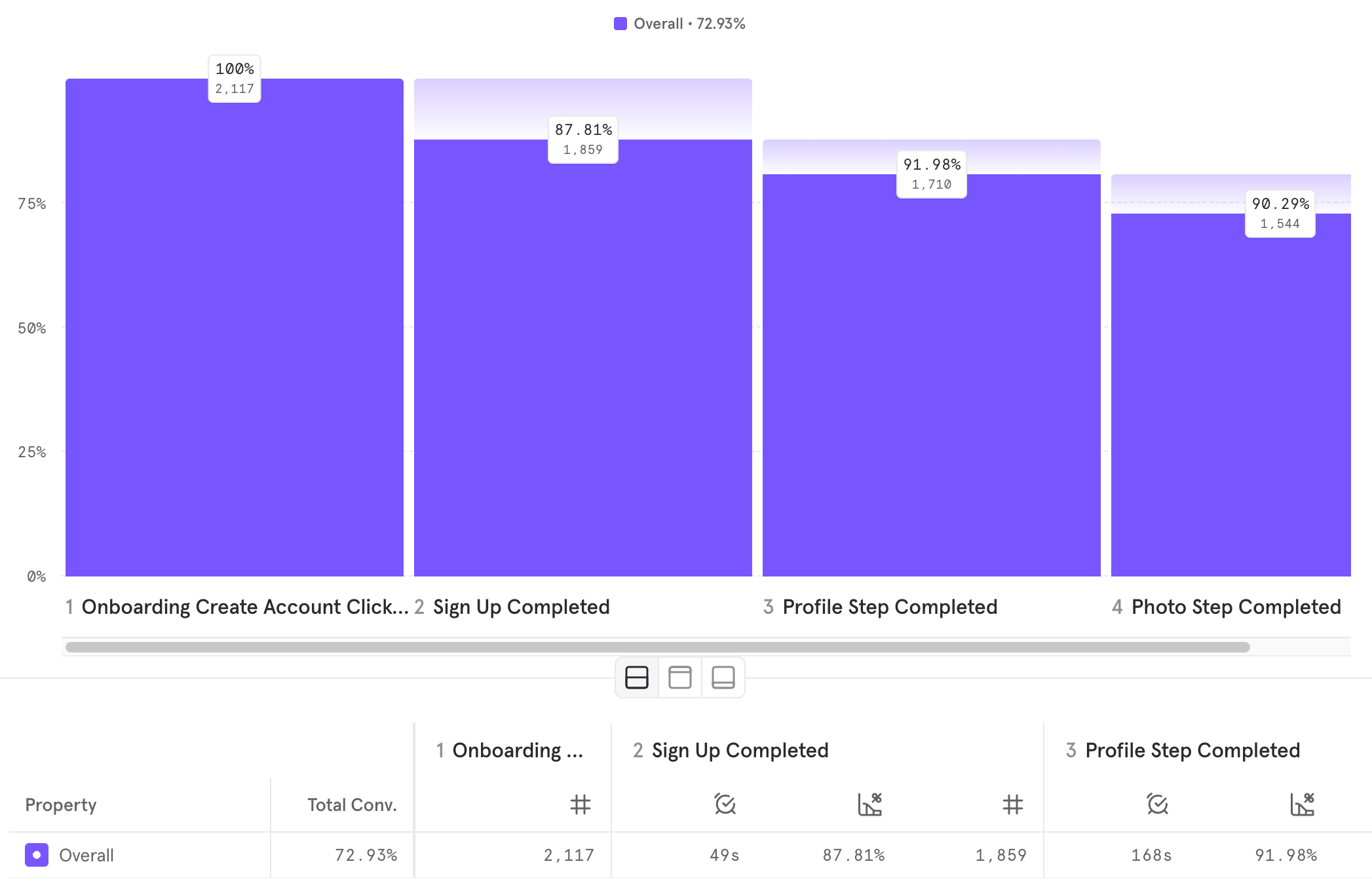
Here is a sample Mixpanel report built using the events above:
Analyzing the Data
When you look at this report in Mixpanel, you are looking for two things:
Overall Conversion: (e.g., 72.93%). If 100 people start, how many finish?
Time to Convert: This is often overlooked. If the gap between Sign Up Completed and Profile Step Completed is 168 seconds, that’s nearly three minutes of friction.
Founder Tip: Your goal is to increase the conversion % and decrease the time. High friction during registration is the silent killer of paid acquisition campaigns. You can also segment this data: Do iOS users convert faster than Android users? Do men drop off at the photo step more than women?
2. Setup
The goal: Ready to mingle.
Let’s define what the Setup Moment actually is. The Setup Moment is considered complete when the user has performed the minimum necessary actions required for the product to work for them.
In a dating app, this means two things must happen:
The User’s Job: They must fill out their profile and upload photos. (Usually, they do this during the Sign-Up flow).
The Platform’s Job: The profile must be verified and approved.
You cannot consider a user “Set Up” just because they finished registration. If their photos are pending or their bio is empty, the product does not work for them yet because they are invisible to others.
This brings us to Moderation. Moderators must review not just the photos, but also open-ended text fields like “About Me” or Profile Prompts.
Photos: Users might upload inappropriate content that violates store policies.
Text: Users often use the “About Me” section for spam, ads, or offensive content.
Until this content is vetted, the user cannot be shown in the discovery pool. In SkaDate, we track the event Avatar Approved.
This is your operational bottleneck. If a user registers on Friday night but isn’t approved until Monday morning, they are “invisible inventory.” They can’t get likes, they can’t get matches, and they certainly won’t feel any value.
Below is the funnel showing the path from Registration to Approval.

Looking at the chart above, you can see that the average approval time is 10.3 hours. This is a major issue because during these 10 hours, the user is completely invisible in the catalog. Other people cannot see them, cannot like them, and cannot match with them. We clearly need to accelerate this process—ideally reducing it to minutes—to prevent that user from churning before they even start.
3. The “Aha!” Moment
The goal: Proof of value.
First, let’s define it. The Aha! Moment is the precise instant a new user experiences the core value of your product for the first time. It’s the moment the lightbulb turns on, and they stop wondering “Why am I here?” and start thinking “I get it.”
In a dating app, the Aha! Moment isn’t when a user sees a pretty profile. It is when they get a reply to a message. That is the moment they realize: “This works. There are real people here.”
But you need to understand: if you have a Freemium app and a business model like Tinder, users can usually only chat for free if they have Liked each other and formed a Match.

Therefore, it is important to track the intermediate events: specifically, that the user is Liking other profiles, and that the user is forming Matches with them.
So, I recommend building a funnel consisting of these events:
Join Completed
Profile Liked (User takes action)
Profiles Matched (Mutual interest)
Conversation Started (First move)
Conversation Replied (The Aha! Moment)
Your job is to widen this funnel. If users are registering but not Liking anyone, you likely have an Inventory problem (an empty database or bad search results). If they are Liking but not Matching, you have a Liquidity problem (inactive users or poor matching algorithms). And if they are Matching but not talking, you face a Psychological barrier—users are often too shy to initiate or simply don't know what to say.
4. Habit
The goal: Retention.
Once a user experiences “Aha!”, we need them to build a habit. A habit means they use the product automatically—checking for matches while waiting for coffee or lying in bed.
How do we define a Habit Moment?
Slack defines a habit as: “The user exchanged at least one message 4 days out of their first 7 days.”
In dating, we can use a similar metric. We want to track users who engage in a core action (messaging or swiping) repeatedly within their first week.
By the way, Mixpanel has a chart that allows you to see very interesting information regarding this: specifically, how many days within a single week users performed a certain action (for example, sending a message).

For example, looking at this data, we see that 24% of users sent messages on at least 2 days in a week. However, only 0.14% communicated on the site every single day.
I would recommend tracking this Habit Moment with a separate Mixpanel event. For example, as soon as a user sends a message on their 4th day out of 7, we fire the event Habit Moment Happened. This allows you to track the conversion rate and time-to-conversion from Join Completed to this specific Habit Moment Happened.
5. Engagement
The goal: Liquidity and Depth.
Many founders mistake DAU (Daily Active Users) for Engagement. They think, “People are opening the app, so we are good.”
This is wrong. In dating, a user can open the app, swipe 100 times, get zero matches, and leave angry. That user is an “Active User,” but they are actually churning.
Following the Reforge methodology, we measure Engagement based on Value, not just activity. We look at this on three levels:
Level 1: Total Engagement (Volume)
This is the pulse of your marketplace. We track:
Messages Sent (Total)
Conversations Started (Total)
Red Flag: If your Registrations are skyrocketing but your Messages Sent is flat, you are acquiring low-quality traffic. You have users, but you don’t have liquidity.
Level 2: Engagement Per Active User (Density)
We need to know how effective the average user is.
Metric: Average Conversations Started per User (Total Conversations / WAU).
If last month your average user started 3 chats a week, and this month it’s only 1, your product experience is diluting. This often happens when you scale marketing too fast and bring in “tourists” rather than serious daters.
Level 3: Segmentation (The Power User Curve)
Never look at “average” users alone. Split them into buckets using a Frequency Report (often called the L30 or Power User Curve):
Casual Users (”Tourists”): Log in rarely, minimal action.
Core Users: Regular usage, consistent swiping. The foundation of your retention.
Power Users (”Whales”): These users send dozens of messages a day.
Industry Insight: In dating apps, Power Users are critical because they generate the liquidity for everyone else. They are the ones initiating chats and keeping the ecosystem alive. You need to monitor this segment closely—if they burn out, your ecosystem dies.
Summary
You now have the framework for the Value Funnel:
Sign up → Setup → Aha → Habit → Engagement
You have the events to track in Mixpanel. Now you can find your bottleneck:
Losing people at photo upload? Fix your Setup UI.
People register but nobody talks? Fix your Liquidity (Aha Moment).
People talk for two days and leave? Fix your Habit loops.
But remember, making users happy is only half the battle. We are running a business. In the next article, we will tackle the Revenue Funnel—how to turn this engagement into money, optimize paywalls, and maximize LTV.
Stay tuned.
Why Build From Scratch?
Implementing the Value Funnel strategy we just discussed requires more than just a good idea - it requires a sophisticated technical foundation.
Coding every single event, integrating SDKs, and setting up the logic to track “Habit Moments” or “Conversion Time” is a massive development drain. Most founders skip it to save time, and then they launch blind.
This is exactly why we built SkaDate.
We don’t just give you a dating app script; we give you observability out of the box. The Mixpanel integration, the event tracking, and the data structures I described in this article are already built into our core. You don’t need to spend weeks coding analytics. You just turn it on, look at the dashboards, and start optimizing your growth immediately.
Stop guessing. Start measuring.